Artificial intelligence as a support strategy for mathematics learning among university students in the faculty of sciences [La inteligencia artificial como estrategia de apoyo para el aprendizaje de las matemáticas en estudiantes universitarios de la Facultad de Ciencias]
DOI:
https://doi.org/10.32829/gesj.v8i2.245Keywords:
Artificial intelligence; mathematics learning; university didactics; support strategies; personalization of learningAbstract
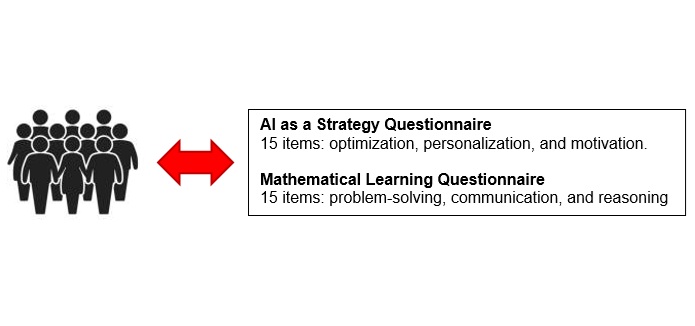
The main objective of this research was to determine the relationship between Artificial Intelligence (AI) as a pedagogical support strategy and the mathematics learning process in first-cycle students of the Faculty of Sciences at the Santiago Antúnez de Mayolo National University (UNASAM), during the 2025-I academic semester. The study is based on the growing need to adapt teaching methodologies to the digital era. The methodology adopted was an applied type, with a quantitative approach and a correlational level of non-experimental and cross-sectional design. The population and sample were census-based, made up of 104 students. For data collection, two questionnaires structured under the Likert scale were used, which were validated by expert judgment and subjected to reliability tests using Cronbach's Alpha. The results obtained through the Spearman correlation coefficient showed a value of with a significance level of . These findings allow us to conclude that there is a direct, positive and very high intensity relationship between the use of AI and mathematical learning. It was demonstrated that the dimensions of optimization, personalization and motivation enhanced by AI significantly influence the problem-solving capacity, communication and logical-mathematical reasoning of university students.
Downloads
References
Ahmed, M., Rabea, A., & Abdullah Abdulkareem, B. A. (2021). The Reality of Using Artificial Intelligence Techniques in Teacher Preparation Programs in Light of the Opinions of Faculty Members: A Case Study in Saudi Qassim University. Multicultural Education. Vol. 7 Num 1, 5-16.
Alonso, C. M., & Gallego, D. J. (2003). Cómo diagnosticar y mejorar los estilos de aprendizaje. UNED, Formación Permanente.
Ausubel, D. (1985). Psicología Educativa. Un punto de vista cognoscitivo. México: Trillas.
Carrasco, S. (2009). Metodología de la Investigación Científica. Lima: Editorial San Marcos.
García Murga, J. A. (2024). Influencia del uso del ChatGPT en el rendimiento académico de alumnos de odontología de una universidad particular de Lima. Universidad César Vallejo. Lima: Tesis de maestría. Maestría en Docencia Universitaria.
Gonzáles Jiménez, P. F. (2024). Uso de la Inteligencia artificial en la enseñanza de matemática en el nivel de ducación secundaria. Universidad de Loja. Ecuador: Informe de tesis. Licenciado en Pedagogía de las Matemáticas y la Física.
Hernández Sampieri, R., & Mendoza Torres, C. P. (2018). Metodología de la investigación. Las rutas cuantitativa, cualitativa y mixta. México: Mc Graw Hill Education. DOI: https://doi.org/10.17993/CcyLl.2018.15
Horizon. (2023). Teaching and Learning Edition. EDUCAUSE Horizon Report.
Luzuriaga Jaramillo, H. A., Hidalgo Cajo, D. P., Avilés Luna, E. S., Calderón Zambrano, R. L., & Mata López, J. C. (2023). Impacto de las tecnologías educativas digitales y rendimiento académi-co en matemáticas. Runas: Journal of education & Culture. DOI: https://doi.org/10.46652/runas.v4i8.118
Moral Sánchez, S. N., Ruiz Rey, F. J., & Cebrián de la Serna, M. (2023). Analysis of artificial intelligence chatbots and satisfaction for learning in mathematics education. IJERI: International Journal of Educational Research and Innovation, 1-14. DOI:https://doi.org/10.46661/ijeri.8196. DOI: https://doi.org/10.46661/ijeri.8196
Porcelli, A. M. (2021). La inteligencia artificial y la robótica: sus dilemas sociales, éticos y juridicos. Derecho Global. Estudios sobre Derecho y Justicia. Vol.6 Num. 16, 49–105. DOI: https://doi.org/10.32870/dgedj.v6i16.286
Ruiz Loza, S., Medina Herrera, L., Molina Espinosa, J., & Huesca Juárez, G. (2022). Facilitating Mathematical Competencies Development for Undergraduate Students During the Pandemic Through ad-hoc Technological Learning Environments. Frontiers In Education, Vol. 7, https://doi.org/10.3389/feduc.2022.830167. DOI: https://doi.org/10.3389/feduc.2022.830167
Soto, M., & García, A. (2013). El aprendizaje escolar un reto para la escuela contemporánea. Curso 27. Congreso Internacional Pedagogía 2013. Ministerio de Educación. Habana: Sello editor Educación Cubana.
Velasquez Peña, E. A., Ulloa Reyes, L. G., & Hernández Mujica, J. L. (2011). Hacia un aprendizaje reflexivo. Por una Educación mejor y más eficiente. Editorial Académica Española, 52.
Yoplac Ramirez, K. J. (2024). Inteligencia Artificial y percepción del rendimiento académico en estudiantes de una institución educativa del distrito de Villa el Salvador 2024. Universidad César Vallejo. Lima: Tesis de maestría. Administración de la Educación.
Downloads
Published
How to Cite
Issue
Section
License
Copyright (c) 2026 Journal of Global Education Sciences

This work is licensed under a Creative Commons Attribution 4.0 International License.


